


There are comeback stories.
And then there’s the karure, the Chatham Islands black robin.
Today, our mates and conservation partners at Forest & Bird announced the karure as New Zealand’s 2026 Bird of the Year. A tiny, jet-black bird from Rēkohu Chatham Islands has taken the top perch in a competition that saw record participation from people around the country.
Which is a pretty decent Monday for a species that, not all that long ago, was down to five birds on the entire planet.
Five.
You could have put every surviving black robin in a Toyota Corolla and still had room for the groceries.
And yet here we are.
Not extinct.
Not a sad little paragraph in a natural history book.
Still here. Breeding. Scratching around in the leaf litter. Causing a bit of a stir.
And now Bird of the Year.
From five birds to hundreds
The black robin story is one of those conservation tales that sounds almost too precarious to be true.
Once found more widely through the Chatham Islands, the species had been pushed into an increasingly tiny corner by habitat loss and introduced predators. By 1980, things had reached the point where there were just five black robins left in existence.
Even more terrifyingly, there was only one viable breeding pair: Old Blue and Old Yellow.
Basically, the future of an entire species had come down to two very small birds.
No pressure, then.
Old Blue in particular became one of the great characters in New Zealand conservation. Every black robin alive today descends from that tiny surviving population, and her contribution was so important that Forest & Bird later named its conservation awards in her honour.
But this wasn't some miraculous recovery where everyone stood around, crossed their fingers and nature sorted itself out.
People got stuck in.
Hope is lovely. Action is better.
One of the reasons this story means a lot to us at Metalbird is our relationship with Forest & Bird.
Long before the black robin became today's headline, Forest & Bird supporters were helping create the conditions that would give the species a fighting chance.
In the 1970s, Forest & Bird launched a fundraising campaign to restore habitat on Mangere Island. The original plan was to plant 50,000 hardy native trees. New Zealanders got behind it so enthusiastically that the campaign ultimately helped fund 120,000 plants. Those trees grew into shelter, leaf litter and feeding habitat for black robins and other native species.
That matters.
Because conservation rarely looks like someone standing heroically on a hill with dramatic music playing behind them.
Sometimes it looks like planting a tree.
Then another.
Then another.
And doing it thousands of times.
Wildlife Service conservationists, including Brian Bell and Don Merton, also pioneered an extraordinary cross-fostering programme. Because black robins breed slowly, eggs and chicks were placed with Chatham Island warblers and tomtits as foster parents, helping the robins produce more young each season.
By the end of the 1984/85 breeding season, the population had climbed from that terrifying low of five to 38 birds.
Thirty-eight still isn't exactly a crowd at Eden Park.
But when you've started with five, it's a bloody miracle made out of science, persistence and people refusing to give up.
And the comeback is still happening
The really good news is that this isn't simply a historical success story we can pat ourselves on the back about.
The work continues.
Recent Department of Conservation research shows encouraging signs for black robin recovery on both Maung' Rē/Mangere Island and Hokorereoro/Rangatira Island.
In 2022, ten female black robins were moved from Rangatira to Mangere because Mangere's population had become heavily male dominated and faced a serious risk of disappearing. Five breeding seasons later, DOC reported 39 adult birds on Mangere at the beginning of the 2025/26 season, with a far healthier balance between males and females.
Meanwhile, modelling on Rangatira found its population had grown from an estimated 253 birds in 2011/12 to around 340 at the beginning of 2025/26.
Forest & Bird puts the current figure at roughly 350 adult karure across the two predator-free nature reserves.
Five to hundreds.
That's the bit that gets me.
Because we're used to hearing environmental stories told as losses.
Less habitat.
Fewer birds.
Another species in trouble.
And those stories need telling. But every now and then we also need reminding that conservation works.
Not instantly.
Not neatly.
And definitely not cheaply.
But it works.
Winning Bird of the Year doesn't mean the job is finished
Here's the important bit.
The black robin is still classified as critically endangered.
The two islands where it survives are running short of suitable territory, which means the species needs more safe habitat if the population is going to keep growing. Forest & Bird says establishing a third population will be important for the bird's long-term future.
DOC research also backs that up. On Rangatira, population growth appears to be slowing as available habitat reaches its limits. Researchers are now learning more about what these birds need, healthy forest structure, nesting opportunities and plenty of invertebrate food, including beetles, flies and wētā.
So Bird of the Year isn't a retirement party.
It's a megaphone.
That's what I've always liked about the competition.
Yes, there's campaigning. Yes, there's ridiculous bird propaganda. Yes, New Zealanders become strangely tribal about whether a kākāpō can beat a robin for a couple of weeks every year.
Good.
Have some fun with it.
Because underneath all the memes and feather-based mudslinging is something deadly serious: people are noticing these birds.
They're learning their names.
They're learning their stories.
And once you know a story like the black robin's, it's pretty hard not to care what happens next.
Forest & Bird says more than 105,000 people took part in this year's Bird of the Year, with 88% of votes coming from within Aotearoa.
That's a lot of people paying attention to native wildlife.
We'll take that.
The little black bird that refused to disappear
There is something beautifully unflashy about the karure.
It's not enormous.
It doesn't have the swagger of a kea or the glorious weirdness of a kākāpō.
It's small, dark and fairly understated.
But perhaps that's what makes the story even better.
This bird came within a whisker of disappearing forever.
Then conservationists, communities, scientists and ordinary people planting trees and chucking a few dollars into fundraising appeals decided that wasn't going to happen without a fight.
Decades later, their work is alive in the forests of the Chatham Islands.
Hundreds of little black birds where once there were five.
That's hope.
But more importantly, it's hope with its sleeves rolled up.
Congratulations to the karure, our partner Forest & Bird, the Chatham Islands community, DOC, the Chatham Islands Landscape Restoration Trust, and every person who has played some small part in keeping this species on the planet.
2026 Bird of the Year.
Not bad for a bird that nearly wasn't here at all.
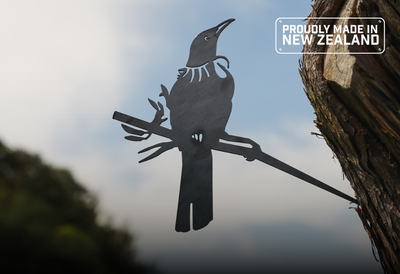
And if you'd like a reminder of why protecting birds matters hanging out in your own backyard, have a nosey through the Metalbird flock, and keep supporting the conservation groups doing the hard work to make sure the real ones stay with us too.
Image: "Black Robin on Rangatira Island” by Frances Schmechel, via Wikimedia Commons, licensed under CC BY-SA 2.0